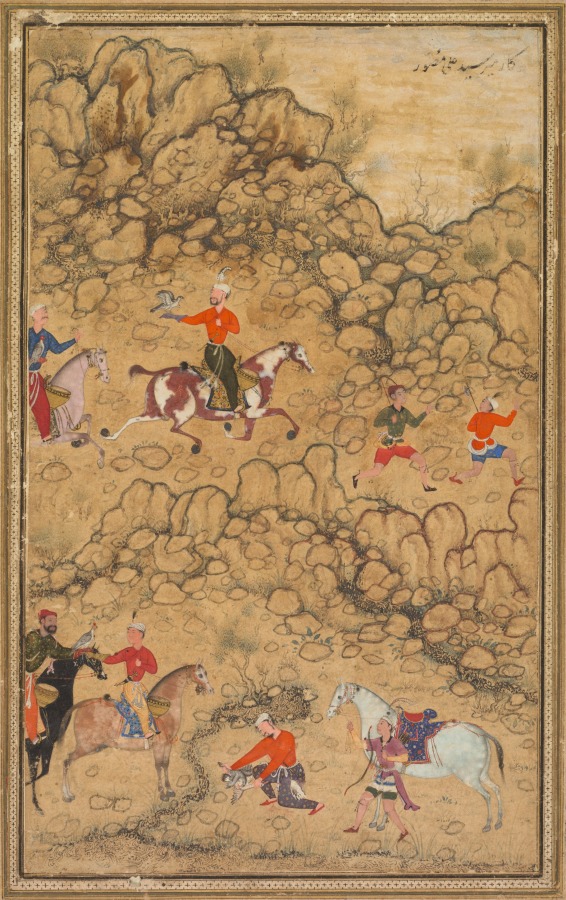
Hunting with falcons in a landscape; verso: Calligraphy of Chaghatai Turkish poems in praise of wine, Sultan Muhammad Nur (Persian, c. 1472–1536) and Mirza Muhammad (probably Persian, active c. 1520s)
Abd al-Samad (Persian
Painting · Gum tempera, ink, and gold on paper
Hunting with falcons in a landscape; verso: Calligraphy of Chaghatai Turkish poems in praise of wine, Sultan Muhammad Nur (Persian, c. 1472–1536) and Mirza Muhammad (probably Persian, active c. 1520s), c. 1558–60; borders added probably 1700s. Attributed to Abd al-Samad (Persian, c. 1510–1600). Gum tempera, ink, and gold on paper; page: 35.7 x 24.3 cm (14 1/16 x 9 9/16 in.); painting: 21.5 x 13 cm (8 7/16 x 5 1/8 in.). The Cleveland Museum of Art, Gift in honor of Madeline Neves Clapp; Gift of Mrs. Henry White Cannon by exchange; Bequest of Louise T. Cooper; Leonard C. Hanna Jr. Fund; From the Catherine and Ralph Benkaim Collection, 2013.292
Descent of Hunting with falcons in a landscape; verso: Calligraphy of Chaghatai Turkish poems in praise of wine, Sultan Muhammad Nur (Persian, c. 1472–1536) and Mirza Muhammad (probably Persian, active c. 1520s)
Annotations from the network
Footnote-style observations from other contributors, folded into the layer's margins. Visible, but quiet.
- 01
Note how the Prussian blue sits in the wave's trough versus its crest — later Hokusai impressions stabilize this gradient, but early pulls like this one still feel like the pigment is being tested against the page.
- 02
The cover of Debussy's 1905 Durand edition of La Mer reproduces this print at the composer's request. A cross-medium lineage worth branching into its own layer.
- 03
Cross-impression XRF of this series (see descendant analysis) supports distinct pulls over the run — not a single uniform batch, but a recarved block drifting as it wore.